
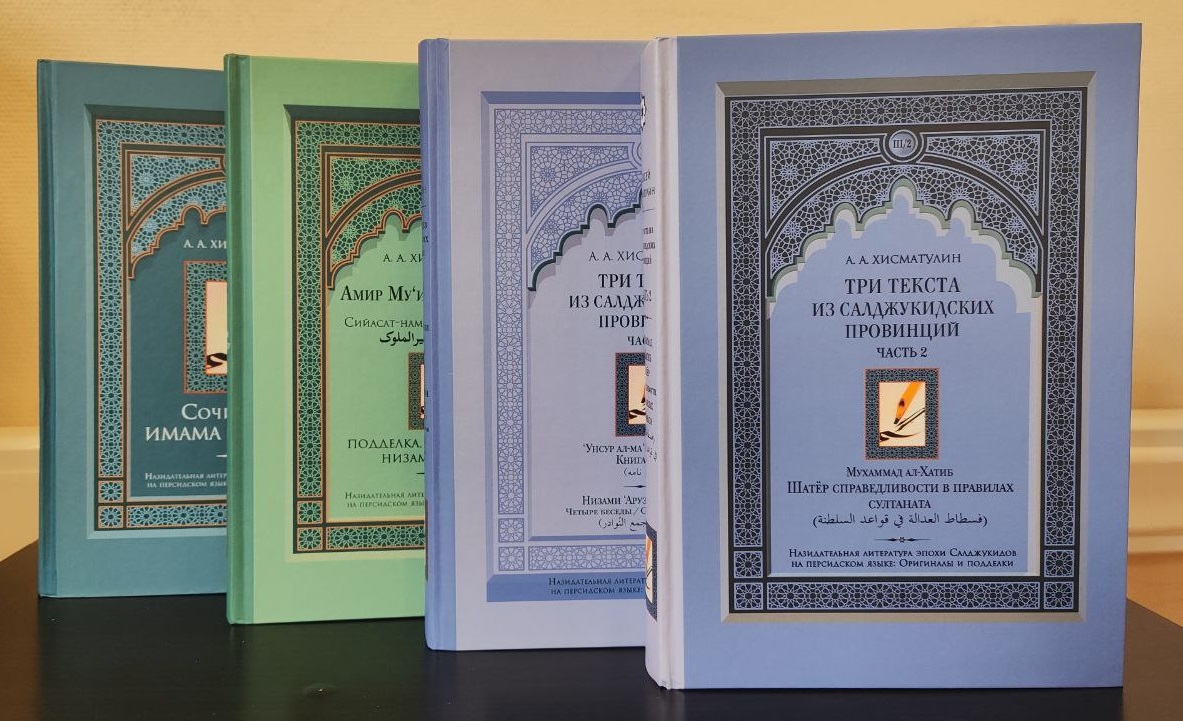
The series “Moralistic literature of the Seljuk era in Persian: originals and counterfeits” was prepared by a senior research scholar of the Institute of Oriental Manuscripts of the Russian Academy of Sciences Alexey Alexandrovich Khismatullin and started to be issued in 2017 with the assistance of the Institute of Oriental Manuscripts of the Russian Academy of Sciences, “Petersburgskoe Vostokovedenie” Publishing House, “Sadra” Publishing House and Ibn Sina Foundation. The series includes four already published books; two of them won awards at the XII Farabi International Festival in 2021. The last three books of the series were issued based on results of competition for publishing grants named after Ibn Sina.
The first book published in 2017 was the second volume of the series “The Writings of Imam al-Ghazali”. It consists of almost all well known small and edifying works in Persian by Imam al-Ghazali created at the end of his life or ascribed to him later.
The first volume of the series was issued in 2020 under the title of “Amir Mu‘izzi Nishapuri. Siyasat-namah / Siyar al-Muluk (“The Book of Governance / The Lives of Rulers”): a Fabrication Ascribed to Nizam al-Mulk”. Siyasat-namah (“The Book of Governance”) and Siyar al-Muluk (“The Lives of Rulers”) are fabrications included into classical Persian literature under two titles. This text has been published and republished under the authorship of Nizam al-Mulk, an outstanding prime minister of Saljukids, up till now.
In 2024 and 2025 two parts of the third volume were also issued: namely, “Three Texts From Saljukid Provinces. Part 1. ‘Unsur al-Ma’ali Kai Qavus. Qabus-namah (“The Book of Qabous”); Nizami ‘Aruzi Samarkandi. Chahar Maqalah / Majma‘ al-Navadir (“Four Conversations” / “The Collection of Parables”) and “Three Texts from Saljukid Provinces. Part 2: Muhammad al-Khatib. Fustat al- ‘Adalah fi Qava’id al-Saltanah” (“The Tent of Justice in the Rules of the Sultanate”).
All the series is represented by 10 basic texts. Five of them are authentic and are considered as belonging to the category of edifying and administrative literature. They give a possibility to comprehend the difference between originals and fabrications. Other five texts are deliberately fabricated or falsely attributed to somebody with evident aims for the concrete audience. The results of published factications research are represented by the following criteria: the way of fabrication, illustrative and evident base, the addressed audience and the aim of fabrication.