
Abstract
The formation of Muslim national historiography in the context of inter-imperial knowledge transfer in the era of creating national states on the ruins of colonial empires is understudied. But it is connected with the key aspects of imperial epoch and the process of nation emergence, hybridization of Muslim historiography and subjective character of historical knowledge. Based on historical writings of Russian and Othoman Turkish religious scholars (‘ulama’), such as Murad Ramzi (1854-1934), Ali Kayaev (al-Ghumuki, 1878-1943), Jamal al-Din Gharabudagi (1858-1947), Yusuf Akchura (1876-1935) and an anonymous writer who used to publish his works in Russian press at the end of the XIX century under various pseudonyms, particularly Murza Alim, the authors of the collective monograph investigated the process of formation and changes in modern historical narratives of former Muslim outskirts of the Russian and Othoman Empires. They analysed the common points and differences, the contribution from the side of Reformists Jadidists (including Kayaev and Akchura) and their role in the development of national historiography in Caucasus, the Volga Region and the former Othoman Empire, including popularization of national history in Muslim periodicals. The book includes original writings of major religious scholars (‘ulama’) of Russia from 1880-s up to the end of the XX century provided with commentaries. The book will be interesting for specialists in the area of Oriental studies, students and PhD students of Oriental faculties and for a wide circle of readers. It can be also used as a textbook at universities.
Imprint
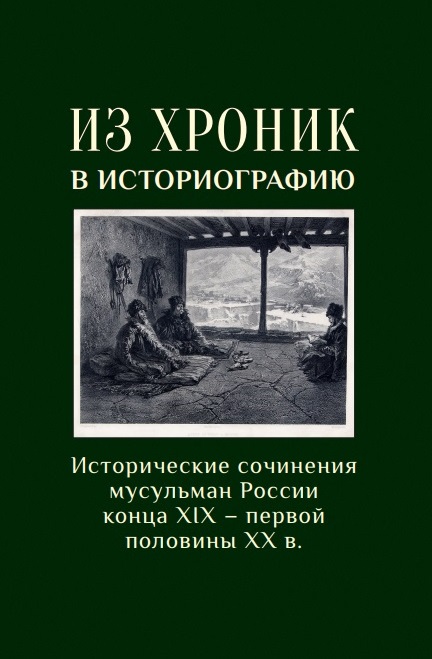
From Chronicles to Historiography: Historical Writings of Russian Muslims at the End of the XIX – the First Half of the XX Century: a Collective Monograph / edited by V.O. Bobrovnikov, S.Z. Akhmadullin, O.Yu. Bessmertnaya, A.D. Vasilyev, I.A. Kayaev, M.I. Kayaev, A.R. Navruzov, D.Z. Sharafetdinova, Sh.Sh. Shihaliev. — M.: LLC “Sadra”, 2026. — 544 pages.
The Institute of Oriental Studies of the Russian Academy of Sciences and the Institute of History, Archeology and Ethnography of the Dagestan Federal Research Center of the Russian Academy of Sciences participated in preparing the book for publication.